
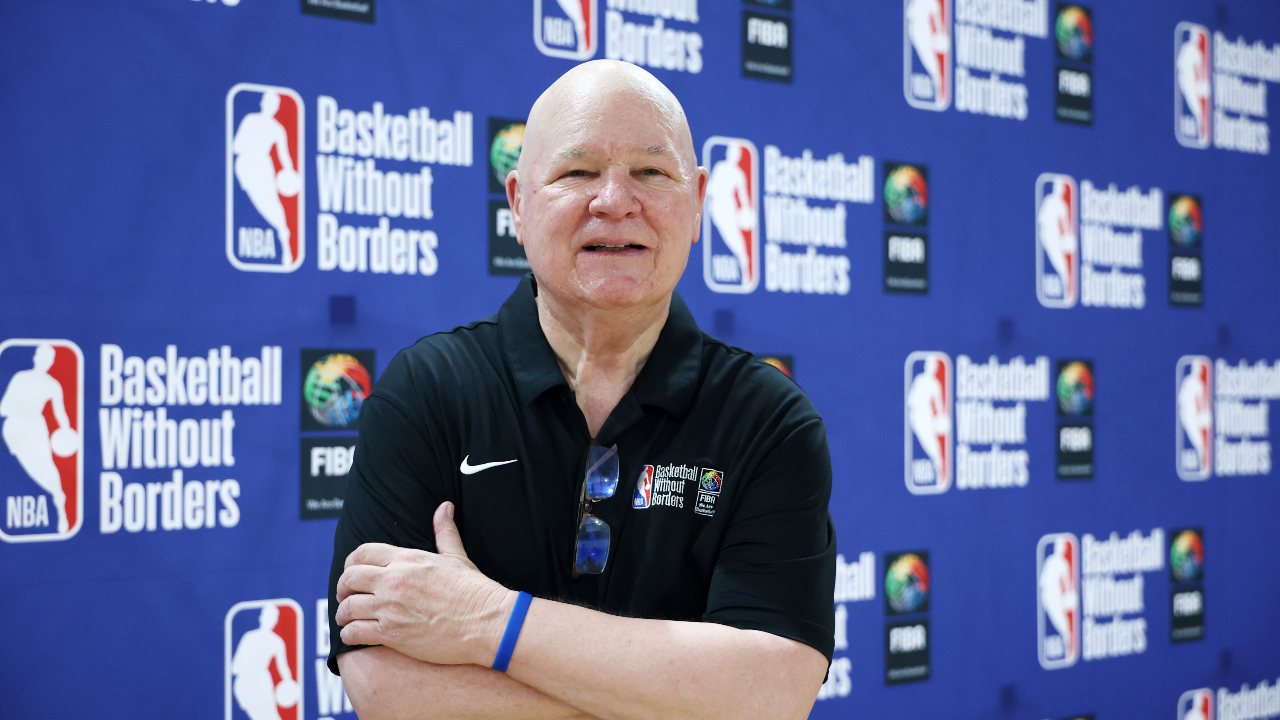
In an officiating career that spanned nearly four decades, Joey Crawford worked countless NBA games. Yet he can immediately single out which ones left lasting memories.
SINGAPORE – By his own estimate, Joey Crawford officiated over 3,000 NBA games. Considering his career ran from 1977 to 2016, that number sounds just about right. He’s also blown his whistle in almost every NBA Finals from 1986 to 2015. He is, without a doubt, one of the most experienced referees to ever grace the hardcourt and has called a foul on just about everyone from Julius Erving to Kyrie Irving.
Given the sheer volume of NBA games under his belt, is it even possible for Joey Crawford to recall the most memorable ones? As it turns out, it was an easy choice.
“Great question,” was his initial reply when asked by The GAME in an exclusive interview at the Singapore Basketball Centre where he is conducting referees’ clinics as part of Basketball Without Borders Asia 2025.
“Now you see that there’s going to be a Game 7 in the NBA Finals, Indiana and OKC. I had three Game 7s in the finals. It was New York-Houston (in 1994). It was Detroit-San Antonio (in 2005) and Boston-LA (in 2010).
“And all those memories are just incredible. Incredible. Because there’s no more games. So every possession, every foul, your stomach is churning, churning, churning. And at the same time, you’re trying to be as calm as you possibly can be.
“So those, they were hard. They’re hard games, but part of the profession, part of the game, part of the job. But they were the three hardest games that I had in my career out of probably over 3,000 games.”
Obviously, refereeing a basketball game is perhaps one of the most difficult jobs in all of sports. Not everyone is cut out for it, but for those who are or think they are, Crawford has three pieces of advice.
“One is to know the rules,” he said. “Sometimes referees go out there and they just guess. But there’s no room for guessing. You have to know the rules. You’re going out there and you’re getting paid, know the rules.
“Two, hustle. Work the game. Work the game. You’ve got to be able to go out there and give those people that are playing an honest effort. Know the rules. Effort on the court. Play calling and getting plays right. A lot of times it’s a matter of opinion.
“The third thing that I think is very important is for these three people that are out here, referees, work in concert with one another. Don’t try to actually overblow your partners. Work in concert. There’s a system that you work. Work the system. And you’re going to have a pretty good game if you all work in concert and try to accomplish the same things.”
Of course, these are easier said than done. Crawford himself acknowledges that it took him a while to master NBA officiating and understand how players think.
“I did 39 years on the NBA floor,” he said. “As my career evolved, I found out that some players have to be on edge more than others to compete. And in my earlier years, I didn’t understand that. And I probably was too quick with the tape. And as my career evolved, I got to know better about the players and how they have to compete.
“And most of the conversations that may be adversarial, it’s usually because of competition. It isn’t because the player dislikes the ref or the ref dislikes the player. It’s usually because of competition. And all players at our level want to win.
“And when you have that kind of dynamic, it’s going to be confrontation. It doesn’t make the players bad guys. It doesn’t make them bad guys at all. It doesn’t make the referees bad guys. It’s just go out, learn from one another, and try to get better.”
Basketball Without Borders
Joey Crawford is in Singapore to spearhead the officiating and refereeing segment of BWB Asia 2025, and he’s spent the last few days working with local referees.
“It’s a great, great venue,” he said of the Singapore Basketball Centre. “We come, we talk about officiating with the referees from Singapore. We have clinics every morning from 9:30 to 10:30. Then they work games. We watch them as they’re refereeing, giving them certain tips on how to call plays, how to get a better angle on plays. So it’s really been awesome because we’ve actually exchanged a lot of stuff that FIBA does and that the NBA does. So it’s really, really good. Really a great exercise in exchanging ideas on officiating.
“The main objective is to get better. Everybody says that all the time, but referees, that is the key. We’ve got to get better. No matter how good we think we are, we can always get better as refs. You’re going to get plays wrong all the time, every game. So that’s the goal. The goal is to get better each and every time that you go out and referee. It’s a process.”
And while Singapore isn’t known as a hotbed for basketball in the region, Crawford has been impressed with the quality of officiating.
“These referees here in Singapore, I’m really, really pleasantly surprised how good they are. The referees that I’ve seen for the last three days, whoever’s teaching them, and I said that in the classroom, I said, ‘Whoever is teaching you guys, keep listening to them. Because they actually know what they’re talking about.’
“And we had an hour session this morning and had plays from NBA games. So what we teach with NBA referees, we were doing with the referees in Singapore. And they were awesome. We gave them a question. They answered it. And really, really, really sharp, sharp answers. So who’s ever teaching them is doing a really good job here in Singapore.”
Getting to officiate in the NBA is the pinnacle for any referee, regardless of nationality. Yet unlike the current landscape of NBA players, which has seen a dramatic increase in foreign-born cagers, the referees’ pool has for the most part remained the domain of American-born professionals.
Crawford says this is simply because there are very few slots available.
“When you want to be a referee in the NBA, it’s very difficult simply because there’s only 75 jobs. And then in the G League, there’s only 75 jobs in the minor leagues of the NBA. So you have to be really, really good.”
And for those aspiring to follow in his footsteps, particularly those in Asia, he has simple advice.
“You have to have one quality. And that’s don’t give up. That’s your dream of what you want to do. I don’t know if it’s true, but I was told that a Filipino referee was going to be in Las Vegas this summer where we train referees in the summertime, which is like an 11-day event. It’s awesome. It’s your classroom every day. You’re watching those referees every day.
“And don’t give up. You’re going to have ups and downs. But if that’s your dream, pursue it. Because you’re going to get better and better and better and better. Especially if you get the tutelage from the people that work with me. They are really, really fabulous teachers.
“So even if you don’t make it in the NBA, you have improved your officiating.”
Banner Images from the NBA.